Are you constantly searching for ideas for making learning stick in your classroom? Does this sound familiar? You taught a solid lesson on Tuesday. By Friday, half your students look at you like you’ve never mentioned the topic before.
Here’s what I’ve learned after more than four decades in classrooms: the problem almost never has anything to do with the kids. It has to do with how we’re asking the brain to hold onto information.
When learning is neutral, flat, or predictable, the brain treats it as background noise. But the moment you add emotion, surprise, or novelty, something shifts. The brain wakes up, pays attention, and actually files that information away. It’s making learning stick!
That’s not a teaching opinion. That’s brain science.

Ideas for Making Learning Stick: It’s All About Attention
Emotion drives attention, and attention drives memory and learning. Think about your own life. You can probably remember exactly where you were when something surprising or emotionally charged happened. You might not remember what you had for breakfast last Tuesday, but you remember the moments that made you laugh, gasp, or feel something.
Your students’ brains work the same way.
Here’s the good news: the science of successful learning tells us that when an experience carries emotional weight, the brain signals, “This matters. Hold onto this.” New information that arrives with emotion attached moves from short-term memory to long-term memory far more reliably than information delivered in a flat, predictable way. When something surprises us, the brain snaps into high alert. When something feels new and different, curiosity kicks in, and curiosity opens the brain like a door.
Here’s the simple truth: you don’t need more time or a bigger budget to make learning stick. One of the most effective ways students remember new material is when emotion, surprise, and novelty are woven into the learning experience.
Adding Emotion to Any Lesson
Emotion doesn’t mean you have to make every lesson a tearjerker. It means giving kids something to feel.
Start a reading lesson with a scenario that genuinely bothers them. “What would you do if your best friend lied to you to protect you? Was that okay?” Watch the room come alive before you’ve even opened the book.
Use a real story. When I introduced a math unit on data and graphs, I didn’t start with definitions. I started with a story about a town that made a big decision based on wrong information, and how that affected real people. The kids were invested before a single number appeared on the board.
Even humor counts. A funny analogy, a ridiculous example, or a well-timed joke creates an emotional hook that makes content stick. Students remember more when they laugh during the lesson than when they sit quietly and take notes. If you haven’t thought much about using humor in your classroom, you might enjoy this blog post: Six Ways Laughter and Humor in the Classroom Make Students Soar

Adding Surprise is Great for Making Learning Stick
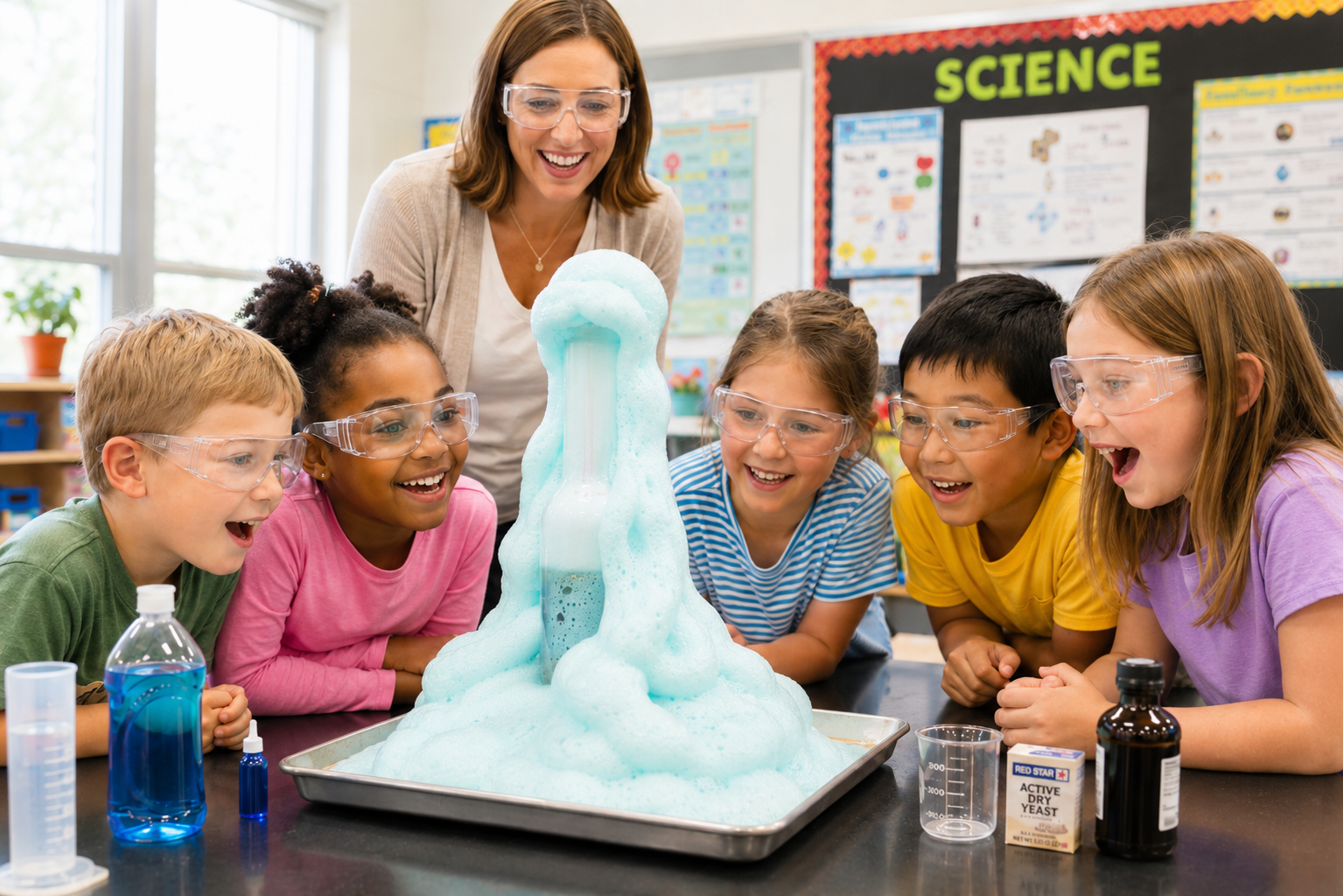
Surprise is one of the most underused tools in any classroom. When something doesn’t match what students expected, the brain sits up and pays attention. That moment of “Wait, what?” is when real learning happens.
Using Novelty in the Classroom for Making Learning Stick
Novelty means variety. New formats. Different entry points. Anything that breaks the routine in a small way, because the brain pays more attention to things that feel different.
One year, during a unit about Ancient Egypt, I wanted to teach about levers and how the Egyptians used them. I got a longboard and balanced it on a concrete post block I found at a building supply store. Suddenly, I had created a teeter-totter! I stood at one end and challenged the kids to use only one hand to press down on the end and lift me into the air. They tried and tried.
I kept on urging them until one kid finally asked, “Can we change the position of the board?” Yes!!!!! They tried all kinds of variations, but discovered that when they shortened the board I was standing on, they could lift me easily into the air. Suddenly, the law: the longer the lever arm, the less effort required to carry the load, became perfectly clear!
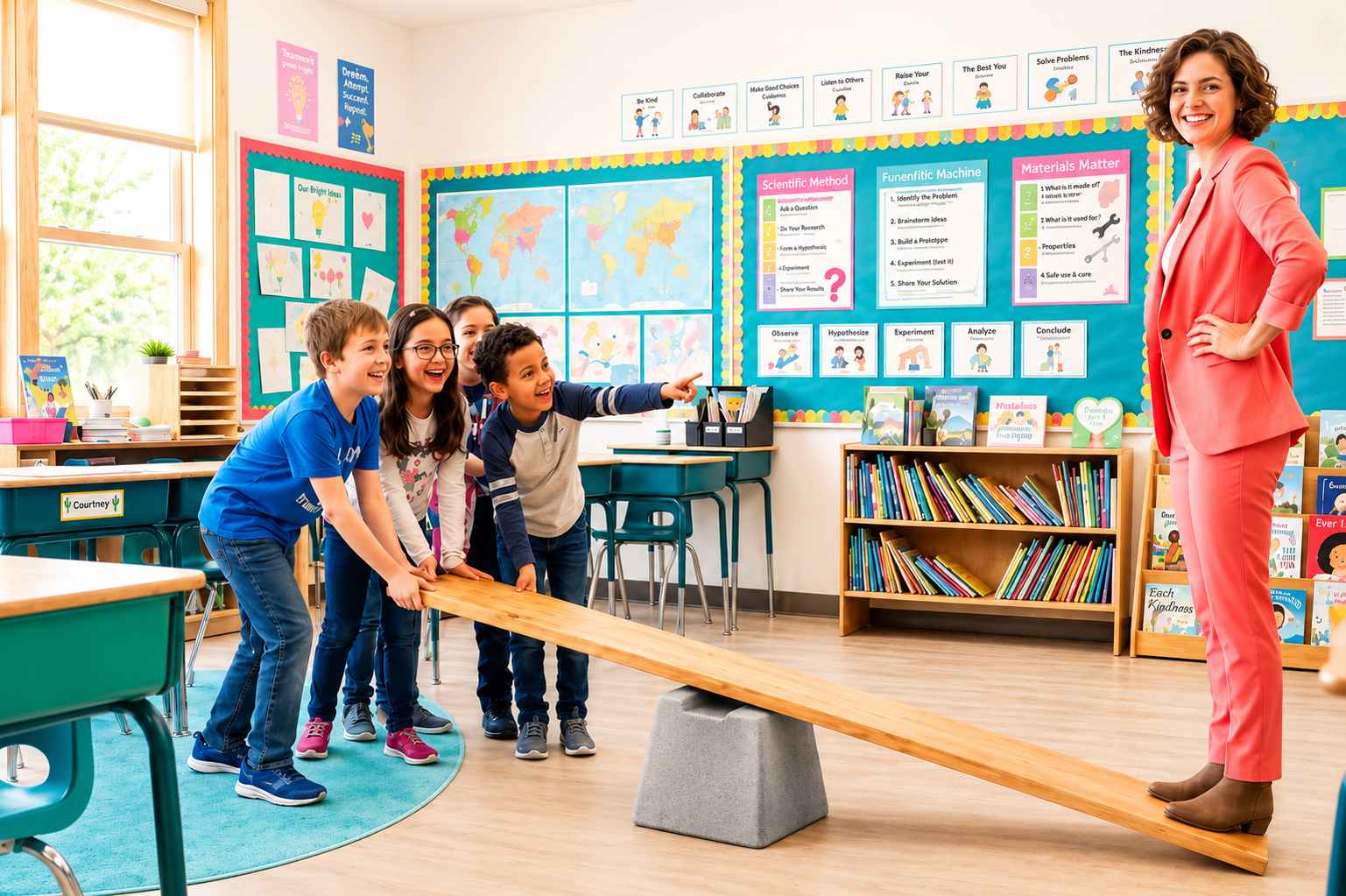
Note: This image is created with AI because I wanted you to have an idea about what we did, so I used AI to help me illustrate the idea. This shows the before. Not shown is when they slid the top board so it was longer on their side of the concrete fulcrum, allowing them to lift me easily.
This kind of experiential learning works because students aren’t just hearing about a concept; they’re living it. That real-world scenario creates mental models that last far longer than any definition written on a board.
The best thing is that this doesn’t require a full lesson overhaul. Try teaching a concept from the perspective of someone who got it wrong. Have students write a “breaking news” headline about what they just learned. Let them argue the opposite side of something just to see if they can. Change where they sit, how they respond, or how they share their thinking.
Even small shifts signal to the brain: pay attention, something different is happening here.
The key is not to do the same thing the same way every single time. Predictability and mindless repetition are the enemies of long-term memory.
If you want to go even deeper on this, my friend Donna Lasher at Big Ideas for Little Scholars wrote a wonderful piece packed with specific lesson ideas for building novelty into your content, your process, and what students produce. It’s a great companion read: Novelty, Surprise, and Twists: How to Sneak These Into Your Lessons
One Easy Routine That Brings All Three Together
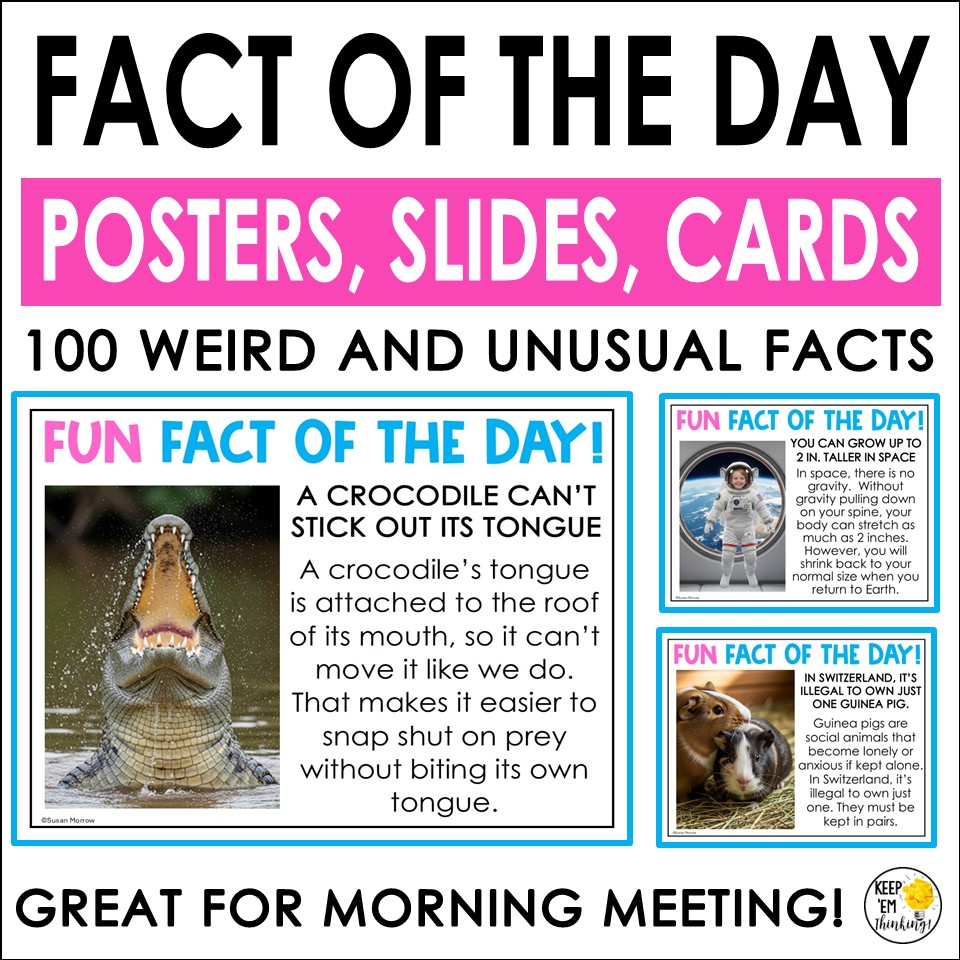
Once you start looking for ideas for making learning stick, you start seeing opportunities everywhere. And one of the simplest ways to deliver emotion, surprise, and novelty all at once, every single day with zero prep, is an activity I call Fun Fact of the Day.
Not a random trivia fact. The kind of fact that makes a kid say “No WAY. Is that real?” and then spend the rest of the day thinking about it, talking about it, and wanting to know more.
That’s the sweet spot. That’s where curiosity lives. And where curiosity lives, learning follows.
Each card kicks off the day with something surprising, weird, or just plain fascinating, and that moment of “wait, really?” primes the brain for learning before the first lesson even begins. Think of it as active recall without the worksheet. You’re pulling students’ brains into a state of readiness, and that matters more than most classroom teachers realize.
Small things done consistently are how you create lasting ways for making learning stick.
What Happens After the Spark
Here’s what I love most about this kind of teaching: the thinking doesn’t stop when the moment ends. It starts.
“How could that even be possible?”
“What if that weren’t true?”
“I wonder if…”
Creating moments of surprise in the classroom lays a solid foundation for making learning stick. When students are intrigued, their minds naturally engage, opening the door to deeper curiosity. It’s amazing how a simple question or a quirky fact can ignite a spark that fuels their passion for exploration. Before you know it, those little sparks evolve into significant projects that reflect their newfound interests and insights.
If you want to take it even further, check out my post on Passion Projects. When students care deeply about what they’re studying, emotion, novelty, and surprise happen naturally. That’s lifelong learning in action.
Tips for Using These Ideas for Making Learning Stick
You don’t have to overhaul everything you do. Here are some practical strategies to get started right away:
- Pick one lesson this week and ask yourself: where’s the emotion? Where’s the surprise? What’s something they haven’t seen before?
- Try spacing out your learning sessions instead of covering everything at once. Returning to key ideas in different contexts over time is one of the most effective ways to move new knowledge into long-term memory.
- Build in moments of active recall. Before you re-teach something, ask students what they already remember. Even an imperfect answer strengthens the memory more than re-reading notes ever will.
- Look for real-world scenarios that connect to what you’re teaching. When students see how key points apply outside the classroom, learning transforms from an isolated activity into something that feels genuinely useful.
- Add one element. See what happens.
- You don’t have to redesign your entire classroom to make learning stick. You just have to give your students’ brains a reason to pay attention.
- Add a little emotion. Throw in some surprise. Keep things fresh with novelty. Do it consistently, even in small ways, and you’ll start to see a shift. Not just in what kids remember, but in how alive your classroom feels.
These are the strategies that make learning memorable for years to come.
If you enjoyed these ideas for making learning stick, you might also be interested in the following blog post:

Feel free to share this post on social media to help others unlock the power of lasting knowledge!
Pin for Later!