
Imagine a young boy listening to the crackling radio broadcast of the Apollo 17 moon landing. With wide eyes and a pounding heart, he turns to his family and says, “I’m going to be an astronaut.”
That boy was José Hernández, the son of migrant farmworkers. Despite numerous obstacles, including being rejected by NASA eleven times, José never gave up on his ultimate goal. In 2009, his sustained effort and unwavering belief in himself led him to space as a mission specialist aboard the Space Shuttle Discovery.
What José had wasn’t just a dream. It was a gritty goal, a long-term goal fueled by perseverance, deliberate practice, and a deep sense of purpose. It was the result of a combination of passion and resilience, a predictor of success that matters just as much, if not more, than natural talent.
Our world needs more kids like José. Teaching elementary kids about setting gritty goals is essential for their future success. It instills in them a sense of resilience, encourages a growth mindset, and prepares them to navigate the ups and downs of life.
What Are Gritty Goals?
Gritty goals are not your everyday goals. They are the bold, challenging aspirations that push us to grow, persist, and achieve over time. Unlike short-term goals, gritty goals often take months or years to accomplish. They require a growth mindset, mental toughness, and the power of grit to follow through—even when the path gets rocky.
In my classroom, I explain it like this: If a SMART goal is the vehicle that gets you there, grit is the engine. SMART stands for Specific, Measurable, Achievable, Relevant, and Time-bound—but without the fuel of passion and perseverance, the car stalls. A gritty goals are SMART goals driven by gritty people who stick with it over the long run.
Take my 9-year-old grandson, Mills. He’s convinced he’ll be a pro athlete. Since he was six, I’ve watched him throwing balls against rebounders, hitting off tees, and now navigating the intense world of kid-pitch baseball. That’s true grit—not just dreaming big, but putting in the hard work every single day.
His story shows that gritty goals can be stretch goals, something challenging that helps kids push beyond their comfort zone for long periods. It’s not about instant success but about developing habits that fuel their own grit.
The Hierarchy of Goals: How We Get There
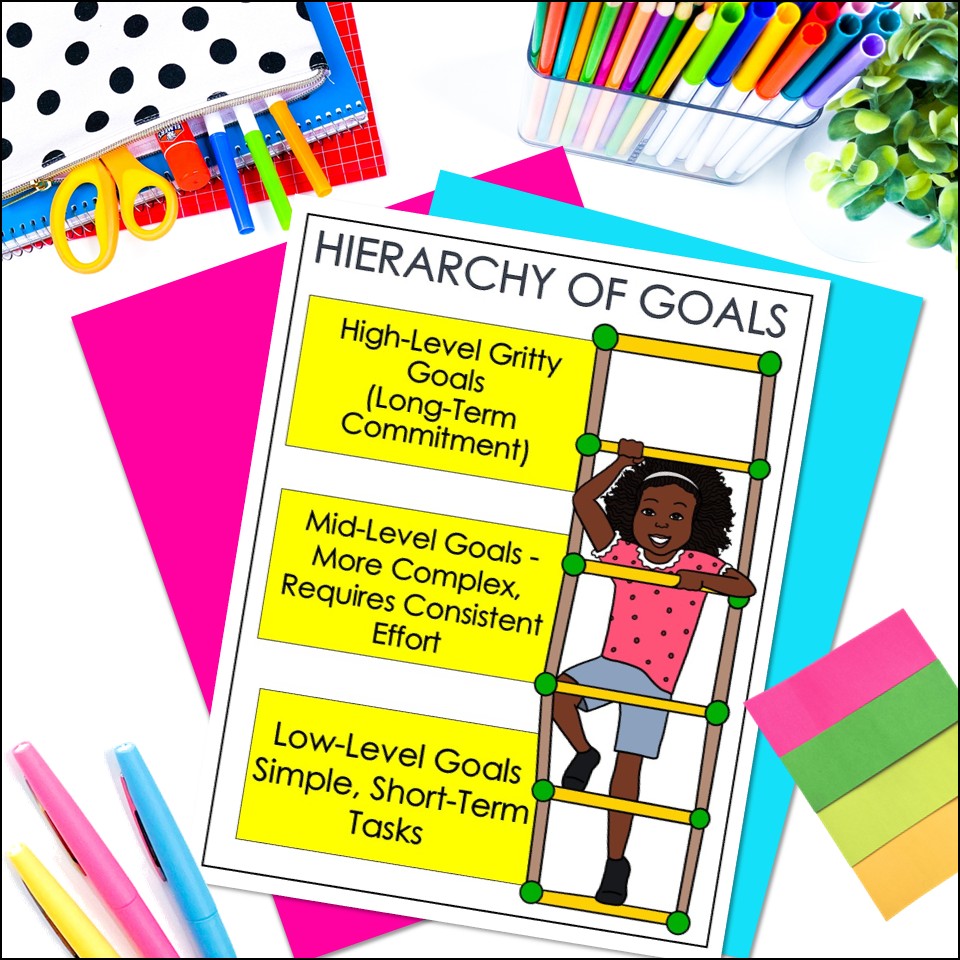
I love using Angela Duckworth’s idea of the goal hierarchy in class. I introduce my students to three levels:
- Low-level goals: Small daily tasks – “read for 20 minutes,” “complete my homework.”
- Mid-level goals: Weekly or monthly commitments – “write a short story,” “finish a science project.”
- High-level goals (gritty goals): Big dreams that take time – “read 50 books this year,” “become the captain of my soccer team,” “learn to play the piano.”
We visualize this structure using the Goals Pyramid from my Creating Gritty Goals unit. Students color and label each level of their pyramid. Then we brainstorm examples for each level, guiding them to understand how their first step connects to their overarching goal.
This structure gives clarity. It teaches kids how to break down their long-term goals into manageable action steps and mini milestones. It also helps them adjust when setbacks come, and they will.
The Connection Between Gritty Goals and SMART Goals
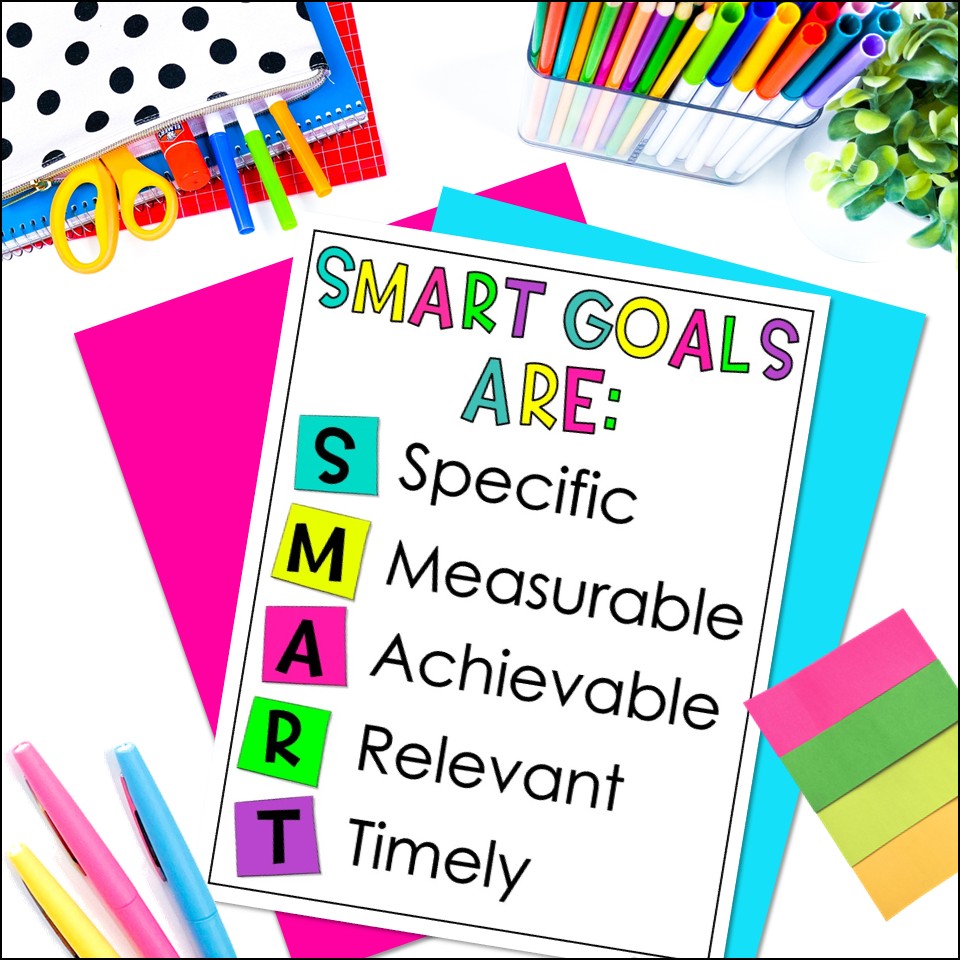
While SMART goals (Specific, Measurable, Achievable, Relevant, Time-bound) provide a framework for effective goal-setting, grit adds the essential element of perseverance. Gritty goals are SMART goals that are pursued with unwavering determination, even in the face of setbacks.
The Importance of Teaching Goal-Setting Early
Teaching kids about goal-setting at an early age has numerous benefits:
Builds resilience: When children learn to set and work towards goals, they develop resilience, a crucial skill for overcoming challenges in their day-to-day activities. Memorizing lines for a play, transitioning from coach pitch baseball to kid pitch, and learning multiple-digit multiplication – setting goals around any of these new challenges helps kids achieve them.
Encourages a Growth Mindset: A Growth Mindset is the belief that abilities can be developed through dedication and hard work. Setting and achieving gritty goals fosters this mindset. For example, if a student sets a goal to improve their math skills, they would believe that with dedication and hard work, they can develop their abilities in this subject. They would approach challenges and setbacks as opportunities for growth rather than as indicators of their fixed abilities. This mindset encourages them to persist, seek help when needed, and embrace the learning process, ultimately leading to continuous improvement and success.
Prepares them for future challenges: Goal-setting skills are essential for success in all areas of life, from academics to careers.
Goal-setting skills are crucial for success in all aspects of life, including academics and careers. By setting and achieving gritty goals, children develop a Growth Mindset, which is the belief that abilities can be developed through dedication and hard work. For instance, if a student sets a goal to enhance their math skills, they will approach challenges and setbacks as opportunities for growth rather than fixed limitations. This mindset fosters persistence, encourages seeking help when necessary, and promotes embracing the learning process, ultimately leading to continuous improvement and overall success.
Impacts academic performance: Students who set and work towards goals are more likely to be motivated and engaged in their studies.
How to Start Goal-Setting with your Students
My Personal Journey with Goal-Setting
There are numerous ways to approach goal-setting in the classroom. I remember trying to help my students set goals for the new school year. I thought I had it all figured out—I handed out a simple worksheet where students wrote down what they wanted to achieve, and I checked it off my to-do list. Easy, right?
Well, not quite.
I realized that many of my students didn’t really understand what it meant to set a goal, let alone stick to one. They’d write things like, “I want to be better at math” or “I want to read more,” but they had no plan, no roadmap, and no real commitment. And I couldn’t blame them—at that time, I didn’t really know how to teach goal-setting in a meaningful way.
It wasn’t until I stumbled upon the concept of gritty goals that things started to change. Grit—this idea of perseverance and passion for long-term goals—transformed the way I approached goal-setting with my students. Suddenly, it wasn’t just about writing down what they wanted to do; it was about teaching them how to work hard and stick with it, even when things got tough.
Start with their Interests: Discover what your students are passionate about. This will make their goals more meaningful and engaging.
Real-Life Examples of Grit
Michael Jordan is a well-known perfect example of this. Jordan is a legendary basketball player who faced numerous challenges on his path to becoming one of the greatest basketball players of all time. Despite being cut from his high school basketball team, he persevered and went on to become one of the greatest athletes of all time. His story of hard work and overcoming adversity can inspire young students to set and achieve their own gritty goals.
Are my students too young to set goals?
Some people may think kids are too young to set serious goals. Even young children can set and work towards meaningful goals. This helps prepare them for when the goals become much bigger and have much bigger consequences if they are not met. While some may worry that setting goals could be too much pressure for kids, it is essential to have goals that are both achievable and challenging. Maybe that’s a tip we could all use!
There are some amazing resources available to learn more about why setting gritty goals is beneficial for your students.
- Recommended books: Grit by Angela Duckworth, Mindset by Carol Dweck
- Articles: The Power of Grit by Angela Duckworth in The New York Times
- Tools and Resources: Do we link to your product here?
Teach Goal Setting
Before jumping into action, we discuss the best way to pursue a gritty goal by turning it into a SMART Goal. I use colorful posters from my unit and a handout titled “How to Create Gritty Goals” to guide the process.
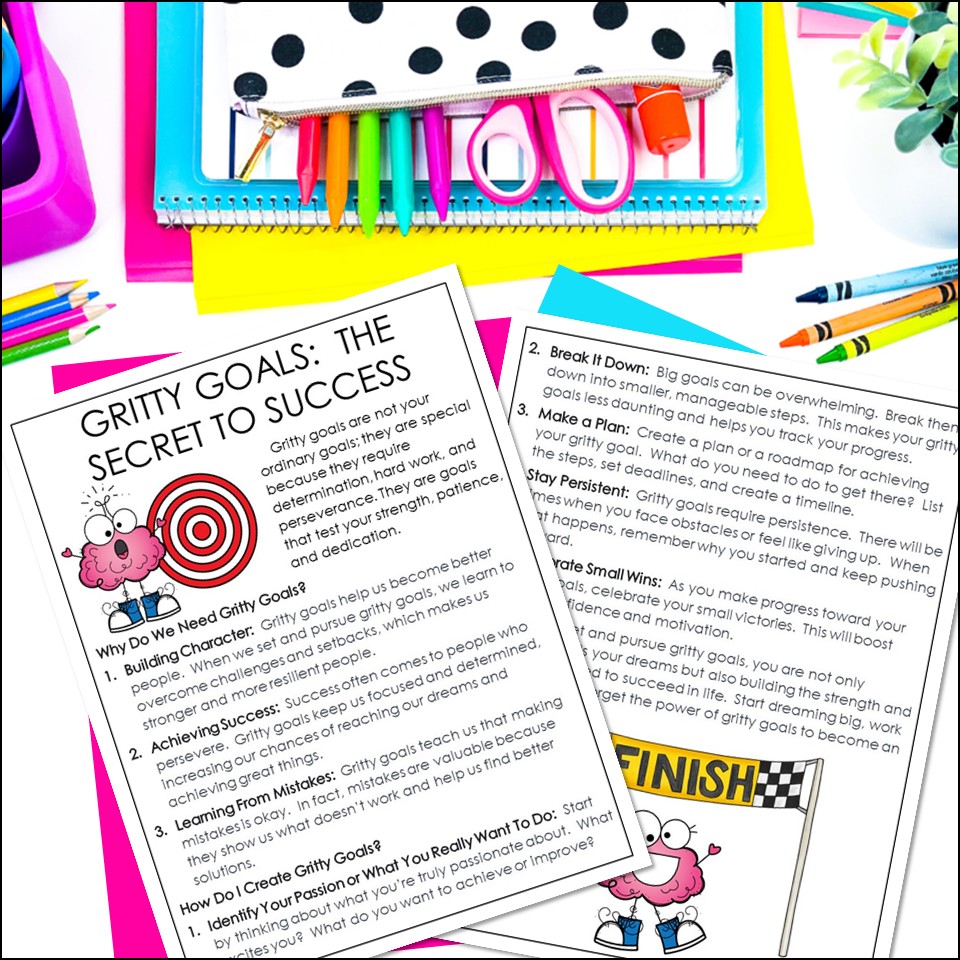
We explore each component:
- Specific – What exactly do you want to achieve?
- Measurable – How will you track progress?
- Achievable – Is it challenging but possible with effort?
- Relevant – Does it align with something you truly care about?
- Time-bound – When will you complete it?
Students then walk through a series of reflection questions:
“Is this something you really want to do?”
“Is it achievable with hard work?”
“Does it have a clear timeline?”
This helps them refine their goal and see how a gritty person uses both motivation and planning. We also talk about the flip side—why some goals fail—and how a fixed mindset can keep us from trying at all.
Map out the plan
Once students have a strong SMART goal in place, we move into action planning. Using the “My Plan” worksheet, they break their big goal into smaller, weekly action steps. We discuss how daily actions connect to long-term outcomes.
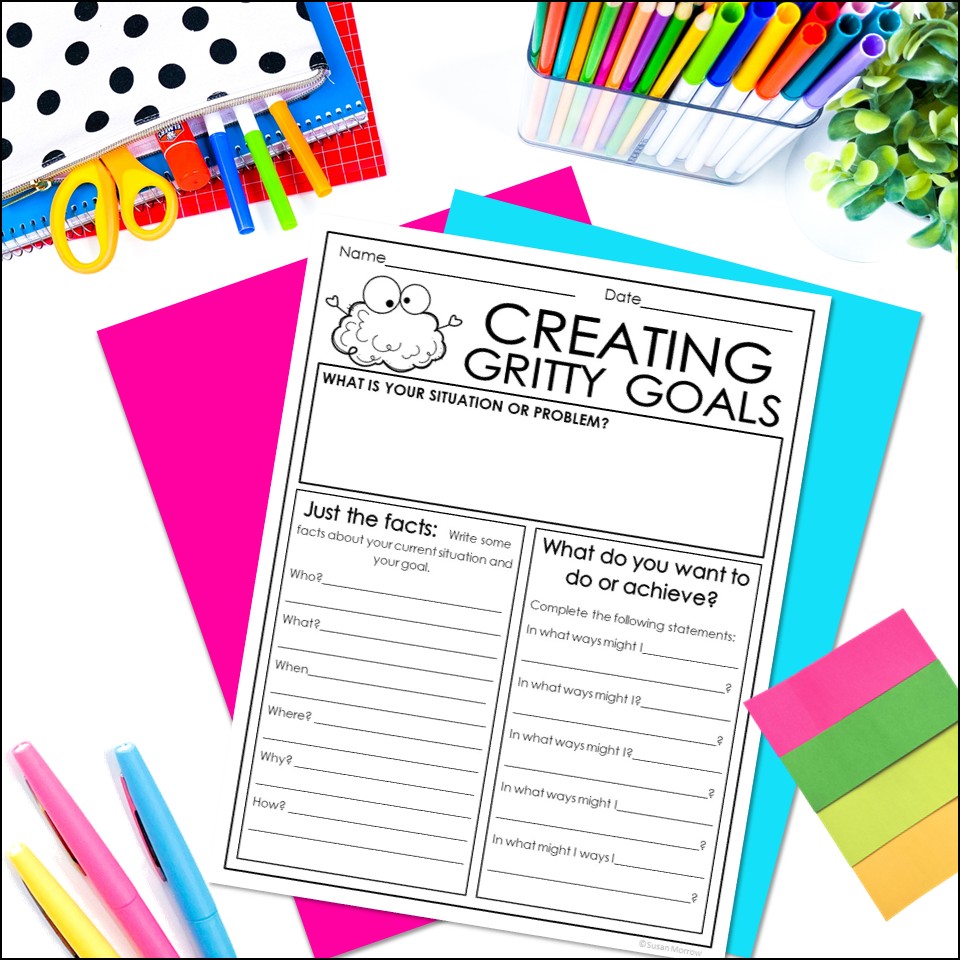
Students:
- Set weekly goal logs
- Use visual tracking tools like graphs and checklists
- List supportive people who can help (family, teachers, peers)
- Predict possible setbacks and brainstorm solutions
This part of the process builds self-control, resilience, and metacognitive awareness. Students learn that grit isn’t about never falling—it’s about getting back up, learning, and trying again. They understand that facing the face of adversity is part of what makes gritty people successful.
We also introduce the hard thing rule (inspired by Duckworth): everyone must choose one hard thing that requires daily effort and can’t be dropped halfway. It encourages kids to stretch themselves and build commitment.
Monitoring Progress and Celebrating Success
Once your students have set their gritty goals and understand the importance of perseverance, the next step is to help them monitor their progress and celebrate their successes along the way. This part of the process is crucial because it keeps students motivated and reinforces the idea that every step forward, no matter how small, is worth celebrating.
Regular Check-ins
One of the most effective ways to keep students on track with their gritty goals is through regular check-ins. This can be as simple as setting aside a few minutes each week for students to reflect on their progress. During these check-ins, I ask questions like:
- What progress have you made toward your goal this week?
- What challenges did you face, and how did you handle them?
- What are your next steps?
These check-ins serve multiple purposes. First, they hold students accountable for their goals. When they know they’ll be asked about their progress, they’re more likely to stay focused. Second, they provide an opportunity for you to offer guidance and support. If a student is struggling, you can help them brainstorm solutions or adjust their approach. Third, check-ins remind students that goal-setting isn’t a one-time event—it’s an ongoing process that requires reflection and adjustment.
Tracking Progress
To make progress visible, I often encourage students to use visual trackers. This could be a chart where they color in boxes each time they complete a step toward their goal, or a journal where they write about their achievements. For long-term goals, I might have students create a timeline or roadmap, marking key milestones along the way.
Seeing their progress laid out before them can be incredibly motivating. It helps students recognize that even if they haven’t reached the finish line yet, they’re making steady progress. And that progress, no matter how small, is something to be proud of.
In the journey toward achieving gritty goals, it’s important to celebrate the small wins. These victories, no matter how minor they may seem, are the building blocks of success. I make it a point to acknowledge these milestones in class—whether it’s completing a challenging assignment, improving a skill, or simply sticking with their goal for another week.
The key is to make students feel seen and valued for their hard work. When they realize that their efforts are noticed and appreciated, they’re more likely to keep pushing forward.
Overcoming Setbacks
Of course, not every step in the journey will be smooth. Students will inevitably face setbacks, and it’s important to help them see these moments as opportunities for growth rather than reasons to give up. During our check-ins, I remind students that setbacks are a natural part of the process and that they don’t define their ability to succeed. The important thing is that they don’t see the setback as a failure, but rather as an opportunity to learn and grow.
Celebrating the Big Wins
Finally, when a student reaches their gritty goal, it’s time to celebrate in a big way! This could be a special class celebration, a certificate of achievement, or even just a heartfelt acknowledgment of their hard work and perseverance. The goal here is to reinforce the idea that all their effort and grit paid off—and that they are capable of achieving anything they set their mind to.
When Grit Isn’t Enough
As much as we encourage our students to persevere and push through challenges, there are times when grit alone may not be enough to achieve a goal. One of the hardest lessons for students (and for us!) is recognizing when a goal may be unrealistic or when the path they’re on isn’t working. This doesn’t mean the student lacks grit; it simply means that circumstances may have changed, or that the goal needs to be modified to better align with their current situation.
Sometimes, a goal simply needs to be revised. This could mean breaking it down into smaller steps, changing the approach, or even setting a new goal. It’s important to emphasize that revising a goal doesn’t mean abandoning it—it means finding a new path to success.
For example, if a student’s original goal was to read five books in a month but they’re struggling to keep up, we might revise that goal to three books. The key is to keep the goal challenging but achievable, allowing the student to experience success while still pushing themselves.
Growth Mindset and the Power of “Yet”
This is where the concept of a Growth Mindset ties in beautifully with gritty goals. When students encounter challenges, setbacks, or need to revise their goals, I remind them of the power of the word “yet.” Instead of saying, “I can’t do this,” we reframe it as, “I can’t do this yet.” This subtle shift in language has a significant impact because it helps students recognize that their abilities are not fixed and that, with effort and perseverance, they can continue to improve.
Encourage your students to keep setting gritty goals, to celebrate their progress, and to learn from every setback. And finally, don’t forget to share your own stories of grit and perseverance with your students. When they see that even their teacher faces challenges and keeps going, they’ll be inspired to do the same.
Picture Books That Inspire Grit
Picture books can bring abstract concepts, such as grit, to life in powerful and memorable ways. Here are a few of my favorites to teach the power of perseverance:
The Most Magnificent Thing by Ashley Spires
This story follows a young girl who sets out to create “the most magnificent thing” but fails repeatedly. Frustrated and on the verge of quitting, she learns that failure is part of the process—and that persistence pays off. A fantastic introduction to the growth mindset.
Rosie Revere, Engineer by Andrea Beaty
Rosie dreams of being an engineer, but one failed invention leaves her too embarrassed to try again. With encouragement from her great-great-aunt, she learns that every flop brings her closer to success. It’s a wonderful example of the hard thing rule and grit in action.
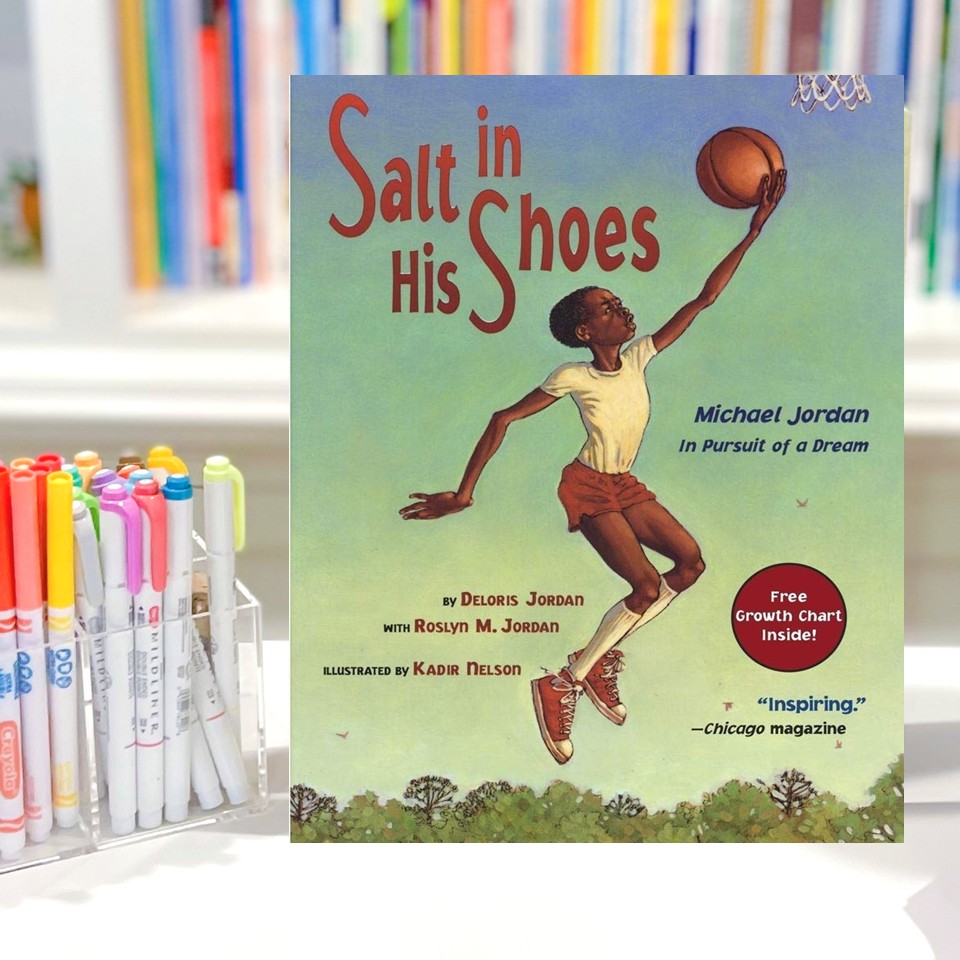
Salt in His Shoes: Michael Jordan in Pursuit of a Dream by Deloris and Roslyn M. Jordan
This biography of young Michael Jordan illustrates how he utilized hard work and dedication to overcome self-doubt and become a basketball legend. It connects beautifully to deliberate practice and peak performance.
Flight School by Lita Judge
A little penguin dreams of flying, even though everyone tells him he can’t. Through creativity and support from friends, he soars in his own way. This story reminds kids that grit isn’t about doing things the way others expect, but finding their own path.
Overcoming Setbacks: Teaching Resilience
Teaching grit means preparing students for the flip side of passion – failure. Setbacks are inevitable. What matters is how students respond. I build in mini-lessons on famous failures and stories of resilience. We talk about:
- Cognitive ability vs. grit: Grit can outperform raw intelligence.
- The importance of reflection and revision.
- Learning to accept detours without losing sight of your ultimate concern.
We also discuss the grit score, based on Duckworth’s research. Students take a simplified version to self-reflect—not to compare scores but to understand their tendencies and areas for growth. It’s powerful to see them say, “I think I need to work on finishing what I start.”
The Grit Scale, developed by Angela Duckworth, is available for free and can be used with kids. The “Grit Scale” or “Grit-S” is a short, 8-item questionnaire designed to assess an individual’s perseverance and passion for long-term goals. It’s not specifically designed for children, but it can be used with older children and adolescents. PsyToolkit provides the scale online and allows for free use.
HERE’S HOW TO ACCESS AND USE IT:
- Access the Grit-S: Go to the PsyToolkit website, which hosts the Grit-S questionnaire.
- Administer the Scale: The Grit-S consists of 8 statements related to perseverance and consistency of interest. Participants respond on a 5-point Likert scale (1 = Not at all like me, 5 = Very much like me).
- Interpret Results: The scale provides a total score, as well as sub-scores for perseverance of effort and consistency of interest. These scores can be compared to established norms (like the average for adults, which is around 3.4) to get a sense of an individual’s grit level.
Final Thoughts
The importance of grit in the classroom extends beyond academics. It’s about preparing students for their entire lives – for the Monday mornings when things don’t go as planned, for the college rejections, the missed goals, and the long climbs to dreams that really matter.
Helping students set gritty goals is about more than teaching goal setting. It’s about giving them a head start in the real world. When kids learn to commit to something challenging, reflect on their progress, and persevere, they’re building the tools for professional success, personal well-being practices, and lifelong achievement.
Want to give your students the structure and inspiration they need to set and stick to big goals? Check out my Creating Gritty Goals Unit. It includes everything you need: posters, brainstorming sheets, goal pyramids, check-ins, and more. It’s ideal for grades 3–5 but adaptable for many ages.
Let’s help our students dream big, stick with it, and discover what they’re truly capable of.
That’s the power of gritty goals.