
Brain Awareness Week is a wonderful excuse to get your kiddos asking questions about the amazing organ inside their heads! How do we remember things? Why does a new skill feel tricky? How does our brain help us make sense of the world?
You can explore these questions with a short daily lesson, a few classroom centers, or a whole-school celebration. I have used brain activities with my gifted students and helped organize a community Brain QUEST event. The hands-on stations were always a favorite! Below are ideas you can adapt for your own classroom, plus a brain unit to help you take the learning further.
Start with My Brain Unit for Grades 3–5
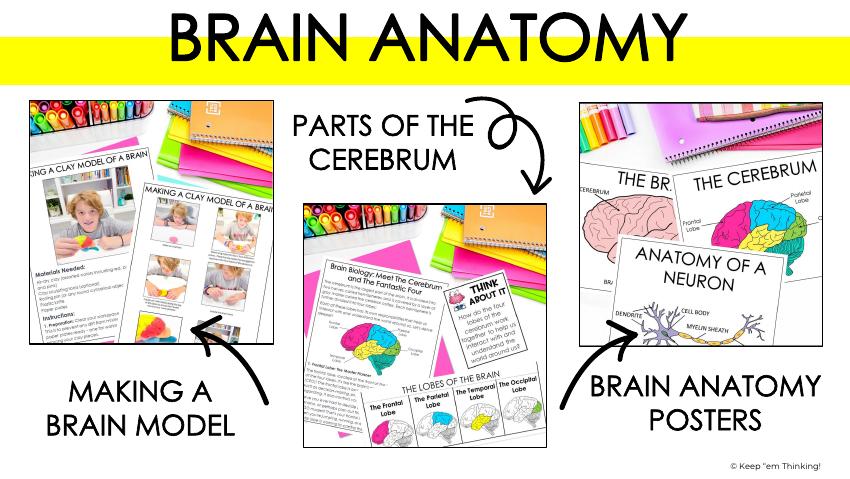
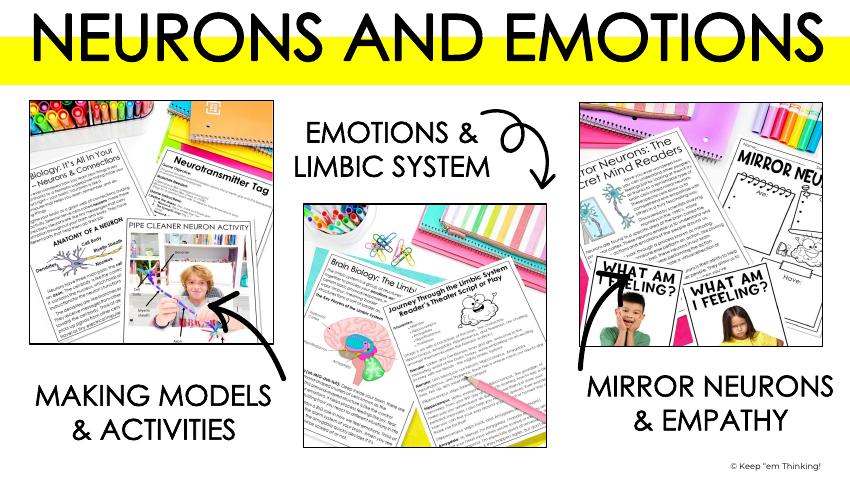
If you want a planned sequence of lessons to go along with your celebration, my Parts of the Brain Activities, Centers, and Worksheets | Human Body Science unit is available in my Keep ’em Thinking TPT store.
The unit connects brain science with the questions students have about learning, memory, emotions, and behavior. Its 11-lesson sequence explores the brain and the mind, brain parts, the cerebrum, the limbic system, neurons, mirror neurons, neuroplasticity, memory, sleep, multiple intelligences, and caring for the brain. It also includes an editable PowerPoint game show, extension activities, and independent project ideas.
Choose a few lessons for Brain Awareness Week, or keep the exploration going as part of a human body or nervous system unit. See the brain unit and preview on TPT.
Begin with a Read-Aloud and Some Wondering
I enjoy sharing Your Fantastic Elastic Brain with younger students to introduce the brain and learning. A Walk in the Rain with a Brain can also start a conversation about the things children enjoy and the strengths they are developing.
Ask students to draw what they think a brain does, then make a class chart of questions. Revisit the chart throughout the week. Encourage children to try different strategies and notice their progress, without putting them into fixed categories of learners.
Bring Brain Science to Life with a Guest
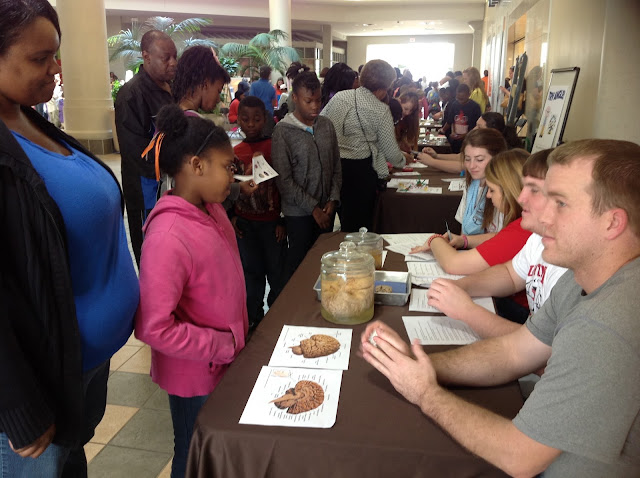
Invite a local college educator or science outreach team to share age-appropriate brain models and answer students’ questions. At one of our events, students were fascinated by the opportunity to see a real brain with visiting educators. You could also invite a community safety educator to discuss bicycle helmets and protecting the brain.
Set Up Your Own Brain QUEST Stations
For several years, our gifted program held Brain QUEST at a local mall. Students helped run booths, and children from across the city visited the activities. You do not need a big venue to try these ideas! Choose three or four stations, gather simple supplies, and give students time to explore and explain what they notice.
Some of our original station ideas were inspired by Brain U’s experiential activities. The photos below show our past event; the classroom adaptations describe ways to try the activities with materials you already have.
1. Nifty Neurons: Make a Model
Use pipe cleaners to model a neuron, including its cell body, branching dendrites, and axon. Have students explain what the parts represent. Talk about learning as changes in connections between neurons, rather than telling children that their brains simply get bigger every time they learn something.

2. Do the Stroop: Name the Ink Color
Write familiar color words in mismatched ink colors, such as the word RED in blue. Ask fluent readers to name the ink color without reading the word. Then compare that experience with naming plain colored squares. Which task takes more concentration? This is an opportunity to discuss attention and how an automatic response can get in the way of a different task.

3. Build a Brain: Explore Its Parts
Our original station used paper brain hats. For an easy classroom adaptation, let students make a labeled drawing or a clay model of the major brain parts. Ask each child to explain one part’s job. Use the brain-parts lessons in my unit to introduce vocabulary before students build their models.

4. Try Angle: Notice What Practice Changes
At this station, children used small Etch A Sketch toys to follow a triangle. You can also try a simple drawing challenge with the non-dominant hand. Give students several attempts and ask what they changed between tries. Focus the conversation on practice, strategies, and progress rather than who finishes first.

5. Let Your Fingers Do the Looking
Place familiar objects inside an opaque bag or box. Students feel one object without looking, describe its texture and shape, and make a prediction. At our event, we used plastic heads from an Operation game, but a simple mystery bag works well! Ask students which clues helped them decide.

6. Memory Matters
Set out a picture-card matching game. After a round, have partners share how they remembered the cards’ locations. Did they describe the pictures, notice nearby cards, or make a mental image? Let them try another round using a strategy they heard from a classmate.

7. Can You Tell What You Smell?
Our original station invited children to identify familiar scents in covered containers. If you include this activity, follow your school’s allergy and scent guidelines and offer a scent-free alternative. Students can record a prediction and explain what the scent reminded them of.

8. Listen Up!
Give partners matching sets of five building bricks and place a divider between them. One child builds a small model, then describes how to recreate it without showing it. Compare the models and discuss which directions were helpful. Switch roles and try again. This station is wonderful for precise language, listening, and revising directions.

9. You Won’t Believe Your Eyes
Let students make a simple flip book with a ball that moves a little on each page. Compare what they see when they turn the pages slowly and when they flip them quickly. Ask them to describe the apparent movement. This version uses blank paper and students’ own drawings, so there is no template to download.

10. Do You See What I See?
Fold a piece of paper with a small dab of washable paint inside, then open it to reveal a symmetrical pattern. Students describe what they see and compare interpretations with a partner. Use the activity to explore observation, imagination, and different perspectives, rather than as a personality test.

11. Daily Doozies
Finish with visual puzzles, tangrams, or craft-stick challenges. Ask students to explain an approach, test it, and revise it if needed. A useful follow-up question is, “What did you try when your first idea did not work?”

A Simple Plan for Your Brain Awareness Week
- Monday: Introduce the brain, collect student questions, and explore its major parts.
- Tuesday: Learn about neurons and build a model.
- Wednesday: Try memory and attention stations, then compare strategies.
- Thursday: Explore the senses and discuss how students used clues.
- Friday: Share discoveries and revisit the class question chart. If you are using my unit, finish with its brain game show.
The stations above are ideas from our Brain QUEST event and classroom adaptations; they are not a list of everything included in the TPT resource. You can pair your favorites with the unit’s lessons and continue the remaining topics after the week ends.
Keep the Brain Learning Going
My favorite part of a brain celebration is hearing students explain their thinking. End with a reflection: “One thing I learned about my brain is…” and “One strategy I want to try is…”
Ready to plan your lessons? Explore my brain unit for grades 3–5 on TPT and open the preview to see the materials. It is a way to connect your celebration with continued learning about the brain, memory, emotions, and learning habits.